I am sitting in my small second-floor study. A soft rain—not the black one that fell on Tehran for days and burned skin and lungs like the sulphuric acid it had become—slides down my new metal roof. It’s the second one I’ve had to get installed in two years. Insurance will pay for it but coverage will mean higher premiums in year where cost-of-living increases are as steady as the rain falling on my house.
The HOA says the new roof will protect against hail and heavy winds. They say nothing about the industrial misuse of the earth behind the changes in climate. Long-term I still worry about my windows: light screens were all that stood between expensive double-glazed windows and the baseball-sized hailstones that broke glass all over the neighborhood during the last storm. And short-term? It’s the price of gas and groceries and whether my 401Ks will survive the recessionary morass our leaders won’t acknowledge is taking hold of the American economy.
***
“First world problems” mean I may worry, but my basic survival is not at issue as it would be in the developing world. When I think of what that term means now, I think of rich and powerful countries creating problems—like war—that are both regional and global. Petrochemical toxins created after American oil field bombings in Iran have created an environmental and public health disaster from which it will take generations to recover. And a now-closed Strait of Hormuz means a loss of twenty percent of world oil and liquified natural gas supply.
***
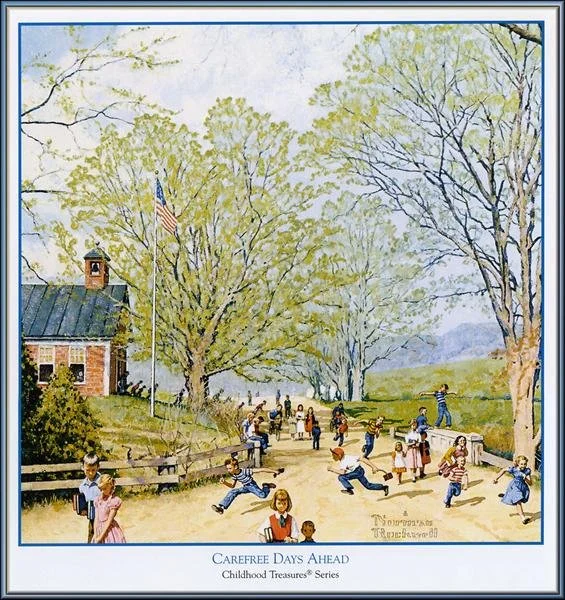
Carefree Days Ahead, 1959
I used to say with amused irony that I live in a Norman Rockwell illustration. If this were the 1950s, my neighborhood might look something like his 1959 print, “Carefree Days Ahead.” The oak and elm-lined streets are tidy, the lawns neatly groomed and nearby stores well-stocked. Signs tell drivers to watch their speed because children who play with basketballs and scooters in peaceful alleys walk to the new middle school two blocks from where I live. Or walk to corner stops where they wait for big yellow buses that take them to elementary or high schools just outside the protective cocoon of the community.
But when I see those children peddling their bicycles around the neighborhood, now, I can only think other children from another school for female elementary students halfway around the world. That school no longer exists; neither do the 150 Muslim girls who never got to ride in big yellow school buses or play in peaceful new-built alleys. Those children can’t ever whisper secrets to each other or be giggly or carefree and silly ever again because of the deadly convergence of a Tomahawk missile and a tactical error a Christian-professing government still has not fully owned.
***
My neighbors, who mostly look like me, are polite and usually smile or say hello. These days, though, they seem distracted. It’s the state of the world and, I suspect, our community. Almost every day we receive alerts about thefts, burglaries and even the occasional assault. Most seem to happen around the local grocery store which also happens to sit at the boundary between neighborhoods unofficially segregated by race and class. Go a quarter mile or so west and then a few blocks north and you will be near both a freeway and a far less affluent area. I feel safe here but even in this picturesque neighborhood, I still have a home security system because you never know.
***
One thing about Rockwell’s paintings is that they were as much inspired by real life as they were meticulously staged. These days his work might be called “curated”: strategically selected, organized and presented to create a particular effect like how viewers might think of Americans or American society. Nostalgic and endearing, Rockwell’s work fed into a national mythology constructed over the twentieth century that came to be called the American Dream. Follow the rules, work hard and earn peace and plenty no matter the circumstances into which you were born.
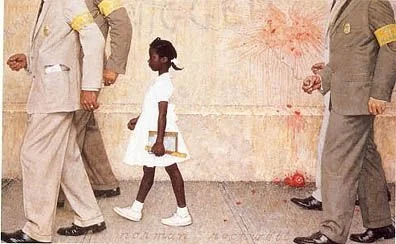
The Problem We All Live With (1964)
That dream is built on the idea that more than enough exists for everyone. But it also assumes that the political drive for social and economic justice exists. And as period has shown, that drive can be hijacked by greed and the highest bidder. That struggle has been one of the darkest shadows underlying the enlightened face America has presented to the world. Yes, this country has defeated tyranny. But it also stolen, enslaved, raped, oppressed, abused and murdered in the name of progress, God or manifest destiny. That shadow, now on full display, is one Rockwell only began to portray in the 1960s, the decade before he died. Like the title of his most famous painting from the era would suggest, that radical injustice is currently “the problem we all live with.” Not just here, but all over the world.
***
I think of woman next door, a very smart woman with an Ivy League-educated daughter, who comes from a country to the east and south of Iran. A laughing blue-eyed ex-boyfriend used to visit her once in a while but he hasn’t visited in a long time. If she and I interact now, it’s by text: The last time I saw her was last year when we got our in-home fire sprinkler systems inspected. I don’t know if it’s because she’s single, brown or quietly uneasy to be both in a majority white community and a country that has embraced the most intolerant and authoritarian parts of its identity. That she may be uneasy makes me uneasy. This is not America, but also very much is America, too.
***
The rain continues to fall pat-pat-pat on my house and neighborhood. Gifted as he was, how would Rockwell, a sentimentalist, have interpreted this jagged mess of a historical moment? Could he have even done it? Looking out at the cloudy sky, I wonder if the better question to ask is whether he would have wanted to paint any of it at all.