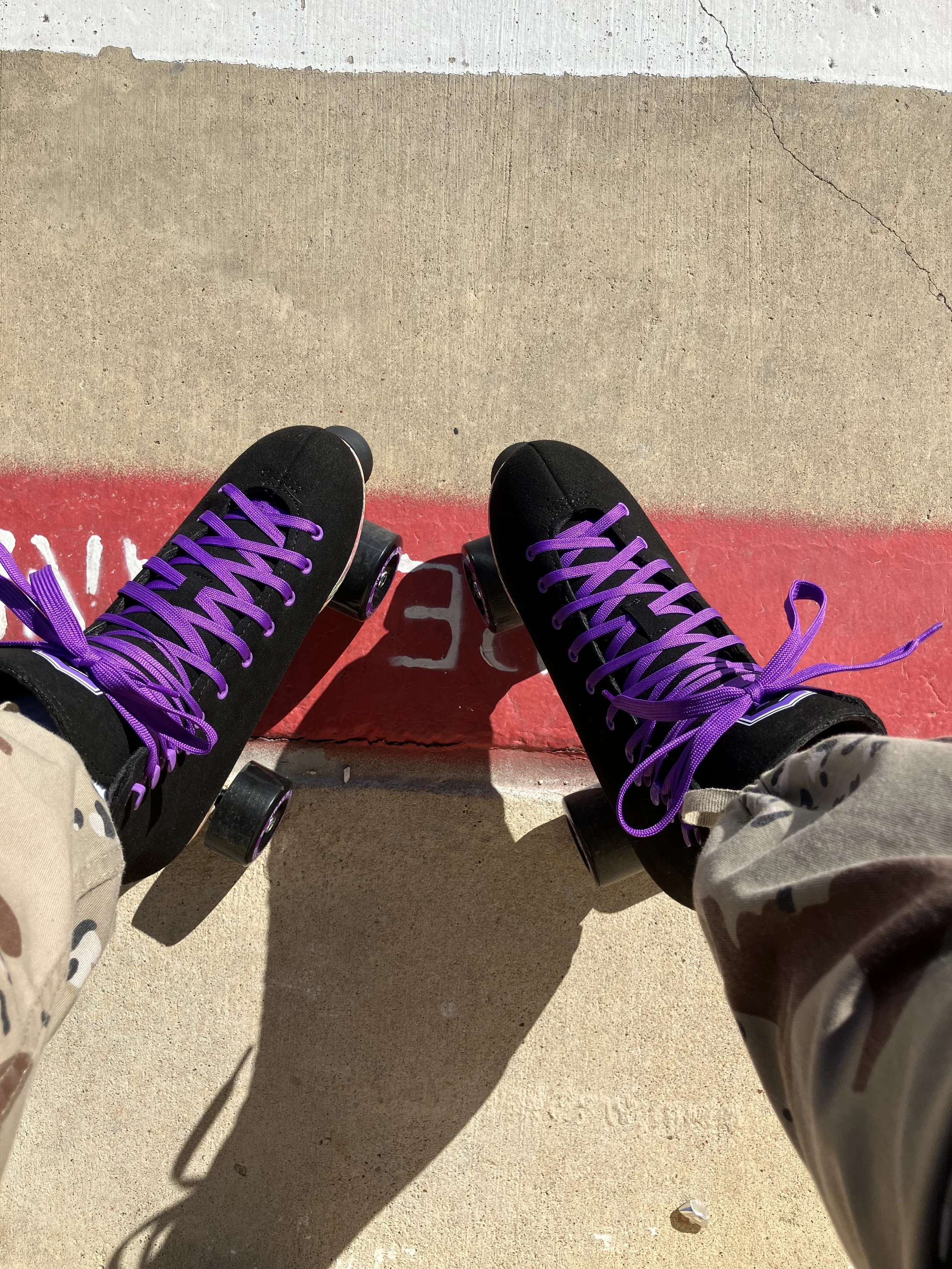
There is something immensely satisfying about the sensation of skate wheels gliding on smooth pavement. I’d forgotten that until recently, when I decided to return to roller skating for physical re-toning after a year-and-a-half of forced rest and more than five years off my wheels. Add to that the focus on self-propulsion through space and on feeling the fluidity of arms and legs working together in effortless rhythm and the act of roller skating becomes downright hypnotic.
I bought my first pair of roller skates with summer money I earned selling lingerie at Robinson’s department store in Santa Monica. Made of reinforced light brown suede, they were Chicago skates with wide orange wheels and neon green toe stops. My earliest stomping grounds were residential streets near my father’s house in Marina Del Rey or the Venice Boardwalk two miles to the west. I wore no protective gear and cared as much about getting hurt as I did about Zen. Everything was only ever about the roll and moving fast and light as air.
At nineteen, my body – and especially my knees – were in prime condition. I could ride low to the ground and move with one leg out, foot balanced on the back wheels of one skate and the other bent up to my stomach. Or I could crouch down near the grown with both knees fully bent before popping straight up and not lose my balance The few tricks I could do were for amusement more than anything else. What I craved was speed.
Once, I rolled across busy streets to the South Bay Beach Bike Path. And kept on rolling easy and fast until I could see the power plants on the cliffs above Manhattan Beach. I could have stopped anywhere along the 7 or 8 miles I traveled and yet I didn’t because I was in a blissed-out flow state I hadn’t yet learned to recognize for what it was and because I ran on an endless supply of energy and fearlessness. Maybe I ached during that roll; maybe there was tiredness afterwards. Those memories do not remain with me. What does is a feeling of the endlessness of sea, sky and time.
When I took to my wheels again at the start of this year, I did it after visiting the local skate park. I was on an evening walk and hadn’t meant to go; I say now that it was a subconscious memory of physicality and motion that took me there. Relative inactivity had caused me to slow down and gain weight; I had also turned 60, which seemed impossibly old. Mesmerized, I watched the skateboarders carve up the park and do 180 flip turns off curved walls. Thinking about the 15-year-old roller skates in my garage, I realized how much I missed that world. And how much I longed to feel the ground fly under my wheels again.
In my eagerness, I did think about how a lack of consistent training might affect my ability to balance on my skates. Or how skating in a confined space with others might affect the Zen of my experience. The weekend day I returned, I found a small area where, protective pads on knees, elbows and wrists, I wobbled rather than rolled. Where had all my balance gone and why I couldn’t maneuver my skates into the T-stops that had once come so easily? More skateboarders charged into the bowl; then children jumped in on scooters. I fell only once, but the longer I stayed, the more uncomfortable it became navigating a human obstacle course.
Exhaustion set in after just one hour. The verdict couldn’t have been clearer: I was out of shape and out of practice. Humbled but determined, I found a large empty parking closer to my house and took a newer pair of skates to practice. The result was the same: slow-rolling frustration, flailing arms and skates that had their own ideas about where they wanted to go. A forward fall that forced my legs into a painful splits made me thankful for knee pads I wore only because I knew what a bad injury could do. A decade earlier, a backward fall tore a ligament in my shoulder blade. I broke no bones but the trauma caused the development of a lipoma I eventually had to ask a surgeon to remove.
Yet for all the mishaps, there was also success. During my session muscle memory awakened just enough to remember that fluid motion came from shifting my weight from side to side rather than picking up each skate. The victory was small but enough to keep me going. I hunkered down with YouTube videos after that and began (re)learning everything I could, from skate maintenance to beginner drills. When one skater extoled the benefits of practicing micro-movements in a small at-home areas, I reorganized my garage. The space that emerged was small, about 8 feet wide and 10 feet long. But it was enough for me to work on gaining back most of the basic skills I’d lost using a minimum of protective equipment.
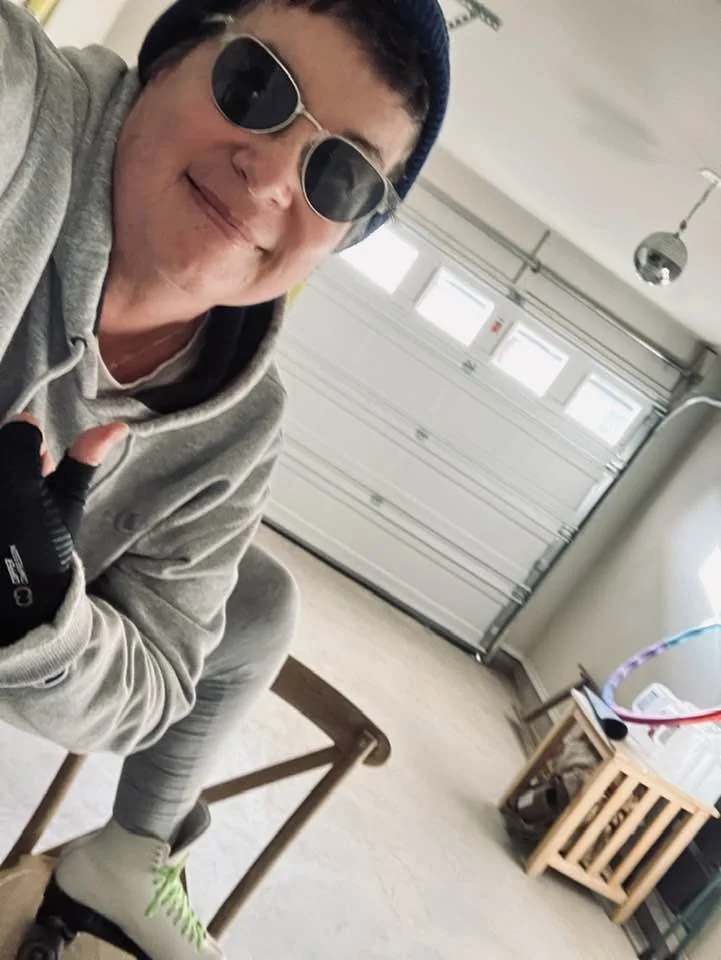
The floor was a dream of smooth concrete. But the first day I tried out the space, I soon learned that floor was not perfectly flat. My wheels suddenly began picking up speed the minute I started cautious movements from one end to the other. Unsure of how to use my toe stops, I ran straight into the closed garage door with a thunk so loud that a dog-walker I saw from one of the garage windows looked up in surprise. Once over my shock, I realized that the sudden burst of speed had delighted rather than dismayed me. Wheels could still make me fly.
I know now that trust, both in my skates and body, needs to be regained before anything like movement flow returns. That will take time as my muscles, fascia and joints awaken from inactivity and I test their strength and limits. In the interim, I’m discovering a different kind of flow, one that comes from concentration on the mastery of the small skills that make up the bigger ones. This has become as rewarding as watching the way rehabilitation is helping to restore the imperfect but brilliant machine I’ve too often taken for granted.
Finding my Zen is still a work in progress. For now, though, I content myself with the physical and technical improvements I’m making, like getting back more stamina and maintaining better balance while moving, turning and doing what the plow stops that keep me from running into the garage door. Because of the awareness it now requires, my skating has become an act of mindfulness that is as much discipline as it is art.